
Agenda Link
Wednesday, July 28, 2010


Tuesday, July 27, 2010
Saturday, July 17, 2010
Gates, CCSS, RttT & Continuing to Follow the Money
Huffington Post: The Most Dangerous Man in America
Business Week: Bill Gates' School Crusade
Education News; Corporate Role in Common Core Standards Ought to Be Exposed: Who appointed Bill Gates Emperor of Education?
Washington Post: Gates Foundation Playing Pivotal Role in Changes for Education System
Washinton Post: Bill Gates' Troubling Involvement with School Reform
Schools Matter: Rotten to the Common Core: When Will Parents and Teacher Revolt?
Rethinking Schools: Keeping Public Schools Public: Testing Companies Mine for Gold
Business Week: Bill Gates' School Crusade
Education News; Corporate Role in Common Core Standards Ought to Be Exposed: Who appointed Bill Gates Emperor of Education?
Washington Post: Gates Foundation Playing Pivotal Role in Changes for Education System
Washinton Post: Bill Gates' Troubling Involvement with School Reform
Schools Matter: Rotten to the Common Core: When Will Parents and Teacher Revolt?
Rethinking Schools: Keeping Public Schools Public: Testing Companies Mine for Gold
Wednesday, July 14, 2010
Does It Resemble a Factory?
“An important question to ask of any proposed educational innovation is simply this: Is it intended to make the factory run more efficiently, or is it designed, as it should be, to get rid of the factory model altogether and replace it with individualized, customized education?” ~Alvin Toffler
School as Community Versus School as Factory
Three images of School
The Odysseus Group: The Business of Schooling - John Taylor Gatto
The Underground History of Education - Gatto
Teacher's Mind Resources
Challenging Assumptions in Education
Sunday, July 11, 2010
Let's Use Normal Language With Kids
by Bob Keteyian
Often, we use words like depression, bi-polar, panic attack, generalized anxiety disorder, and more to describe normal reactions kids have to life circumstances. This can be dangerous and gives kids the wrong message about life and our ordinary human experience in response to adversity.
For example, a teenager breaks up with her girl friend and is feeling down and dejected. Saying she is “depressed” would be common. Today, it can mean something else—Depression with a capital “D.” In a situation like this, I’ve found it better to stay away from “terminology” and use ordinary words to describe what the kid is going through, rather then telling them they may “have” depression and implying (or actually telling) that they should be thoroughly evaluated.
The girl in our above example was dumped by her friend. She’s upset, hurt, sad, angry, and feeling really down. She probably should be feeling all of that, as well as being confused and feeling poorly about herself. She is going through the normal progression of experience in a typical human circumstance. She needs love, support, hugs, understanding, encouragement, and time.
I’m not pooh-poohing depression or minimizing the potentially devastating impact of clinical depression. But I am trying to bring balance and common sense to our observations of kids going through a hard time and subsequently our communication with them.
My first mentor, Ralph, was a child psychiatrist. He passed on a piece of wisdom over thirty years ago that I carry with me today. Paraphrasing: if you describe in detail the behavior and emotions of any teenager, they will qualify for a mental health diagnosis—and some pretty heavy duty diagnoses at that! Teenagers have mood swings, black and white thinking, irrationality . . . etc. I don’t mean this disparagingly. During adolescence there are enormous body/mind changes which are very unsteadying. Any of us adults in a difficult situation will exhibit many of these behaviors, as well. Drawing diagnostic conclusions, though, can be dangerous—especially with kids
Also, we’ve gotten more detailed and sophisticated in our terminology about human behavior but often at the exclusion of common sense. For example, I’ve found myself using old-fashioned terms like “nervous exhaustion” or “nervous breakdown,” when they seem more accurate and helpful. Other choices like “psychotic break” or “bi-polar disorder” just don’t fit and aren’t helpful, and we can all identify with being in a “slump” or “down in the dumps.”
Connecting with others in distress by being patient and emotionally supportive is the first order of business. Expressing kindness and understanding are always helpful, even if it doesn’t have an immediate, discernable impact. Knowing someone cares makes a big difference. It’s simple but true. And communicating using simple, descriptive language is always the best medicine.
Tuesday, June 29, 2010
Marion Brady: Education Reform: An Ignored Problem, and a Proposal
"The most useful thing Congress and state departments of education can do is abandon authoritarian, centralizing initiatives and legislation that dictate what’s taught. By propping up an obsolete, dysfunctional curriculum, they’re making a very bad situation much worse. ~ Marion Brady, Truthout, June 25, 2010

"The 'standards and accountability' education reform effort began in the 1980s at the urging of leaders of business and industry. The reform message preached by Democrats, Republicans, and the mainstream media is simple. 1. America's schools are, at best, mediocre. 2. Teachers deserve most of the blame. 3. As a corrective, rigorous subject-matter standards and tests are essential. 4. Bringing market forces to bear will pressure teachers to meet the standards or choose some other line of work.
Competition - student against student, teacher against teacher, school against school, state against state, nation against nation - will yield the improvement necessary for the United States to finish in first place internationally." ~ Marion Brady, Truthout.
Monday, June 28, 2010
Summer Institute Reminder!

Sessions emphasize hands-on, imaginative professional development opportunities in all content areas. Educators in all grade levels including adult education are welcome with focus on grades 7 through 12.
This year the presentations will encourage activities and resources to help answer to the question: “How can we model and promote ethical, responsible, and productive behavior among all members of our digital society?” The goal - connect to one or more elements of digital citizenship: etiquette, ethics, safety, savvy, presence, and productivity.
Please visit http://maine.gov/mlti/
Sunday, June 27, 2010
Two Stories - Two Pictures
by Robert V. Keteyian
Ned is a very active seven year old boy—tireless and constantly in motion. His continuous imaginative play is captivating, both to himself and to anyone watching him. Within a minute of seeing a stick and a piece of crumpled up paper, for example, he has combined them with other objects to form a spaceship that he weaves in and out of many worlds.
Often, though, it is difficult to get Ned’s attention because he is so absorbed in play/thought/imagination. If you ask him a question or give him direction, he’ll respond as though he’s heard you but he doesn’t follow through…or so it seems. When his parents try to talk to Ned about listening and following through, he seems distracted and uncomfortable, and the session often accomplishes little except giving all involved a not-so-healthy level of frustration. Mary and Kevin, Ned’s parents, are concerned that his level of absorption will cause big problems for him, especially as he gets older.
Mary especially is tireless in her attempts to engage him and help him focus better. As she explored the communication styles framework, she recognized that Ned has a strong visual-spatial and kinesthetic world. He tends to think in pictures and focuses his attention on creating and experiencing. Therefore, using words to connect with him would likely be ineffective.
One day when Ned and Mary were at the park, they watched as two boys, some distance away, played with a ball. When the ball bounced toward them, Ned picked it up and began bouncing it in a pattern relating to the cracks in the pavement. Mary instructed him to return the ball to the boys. Ned replied, “I am.” His mother retorted, “No, you’re not. Give it back now.” The conversation went back and forth like this, and eventually Ned rolled the ball back to the boys.
Then Mary asked him to go sit in a nearby hammock and picture two scenes: the one that just occurred and another where he simply handed the ball back to the boys. Ned sat dreamily in the hammock for about five minutes and then said, “Oh, I get it. I should have given the ball back right away because they were playing a game with it.” Mary saw this as a breakthrough moment, and it was.
Typically in a follow-up discussion of this sort, Ned would defensively explain that he was giving the ball back because, in fact, he was, but it was in a manner that suited him and was not congruent with anyone else’s reality. This time it was different. As Ned tuned into his imaginative world to reflect, he observed his creative process for returning the ball (which he fully intended to do) and observed the scene from the perspective of the two boys. Once he visualized both pictures, he realized what was most important—the right thing to do in this situation. Tapping into Ned’s natural language in the visual-spatial realm gave him an opportunity to connect to a bigger picture and understand what was important to others.
As Mary and I talked about this, we explored the possibility of helping Ned use an imaginary pause button when she’s trying to get his attention. Because the compelling pictures he constantly visualizes makes it hard for him to focus on input from others, learning to press the pause button might help Ned focus on what Mary is saying. It’s an experiment worth trying. Using the communication styles lens often can help us creatively and specifically solve problems.
Ned is a very active seven year old boy—tireless and constantly in motion. His continuous imaginative play is captivating, both to himself and to anyone watching him. Within a minute of seeing a stick and a piece of crumpled up paper, for example, he has combined them with other objects to form a spaceship that he weaves in and out of many worlds.
Often, though, it is difficult to get Ned’s attention because he is so absorbed in play/thought/imagination. If you ask him a question or give him direction, he’ll respond as though he’s heard you but he doesn’t follow through…or so it seems. When his parents try to talk to Ned about listening and following through, he seems distracted and uncomfortable, and the session often accomplishes little except giving all involved a not-so-healthy level of frustration. Mary and Kevin, Ned’s parents, are concerned that his level of absorption will cause big problems for him, especially as he gets older.
Mary especially is tireless in her attempts to engage him and help him focus better. As she explored the communication styles framework, she recognized that Ned has a strong visual-spatial and kinesthetic world. He tends to think in pictures and focuses his attention on creating and experiencing. Therefore, using words to connect with him would likely be ineffective.
One day when Ned and Mary were at the park, they watched as two boys, some distance away, played with a ball. When the ball bounced toward them, Ned picked it up and began bouncing it in a pattern relating to the cracks in the pavement. Mary instructed him to return the ball to the boys. Ned replied, “I am.” His mother retorted, “No, you’re not. Give it back now.” The conversation went back and forth like this, and eventually Ned rolled the ball back to the boys.
Then Mary asked him to go sit in a nearby hammock and picture two scenes: the one that just occurred and another where he simply handed the ball back to the boys. Ned sat dreamily in the hammock for about five minutes and then said, “Oh, I get it. I should have given the ball back right away because they were playing a game with it.” Mary saw this as a breakthrough moment, and it was.
Typically in a follow-up discussion of this sort, Ned would defensively explain that he was giving the ball back because, in fact, he was, but it was in a manner that suited him and was not congruent with anyone else’s reality. This time it was different. As Ned tuned into his imaginative world to reflect, he observed his creative process for returning the ball (which he fully intended to do) and observed the scene from the perspective of the two boys. Once he visualized both pictures, he realized what was most important—the right thing to do in this situation. Tapping into Ned’s natural language in the visual-spatial realm gave him an opportunity to connect to a bigger picture and understand what was important to others.
As Mary and I talked about this, we explored the possibility of helping Ned use an imaginary pause button when she’s trying to get his attention. Because the compelling pictures he constantly visualizes makes it hard for him to focus on input from others, learning to press the pause button might help Ned focus on what Mary is saying. It’s an experiment worth trying. Using the communication styles lens often can help us creatively and specifically solve problems.
Follow the Money . . .

"This group of very rich people ignored this body of research that shows that the single most powerful factor in education gaps is poverty and not standardized testing.
Did they forget that the United States has the second highest rate of children in poverty of any industrialized country in the world?" ~ Cindy Lutenbacher, ajc . . . READ MORE
Poverty and Test Scores: A Critical Analysis ~ Orlich & Gifford, Phi Delta Kappan 10/20/06
Poverty and Education: Overview
Poverty and Learning Wiki
USAToday: More Than 1 in 5 Kids Live in Poverty
Thursday, June 24, 2010
Educational Publishing Oligopoly

In case you might not have noticed, a handful of major educational publishers now dominate the education market, being led by McGraw-Hill and Pearson. These same publishers had great influence in creating the Common Core State Standards.
What are the implications of this concentration of power?
Tuesday, June 22, 2010

Sunday, June 20, 2010
How Important is Critical Thinking?
Question: Is Project-based Learning a Bad Approach for Education?
Discuss:
"Critical Thinking? You Need Knowledge" ~ Diane Ravitch, 9/15/09

Discuss:
"Critical Thinking? You Need Knowledge" ~ Diane Ravitch, 9/15/09
Maine's Race to the Top Application
 Maine's Application
Frequently Asked Questions
Portland Press Herald: "Panel Lets Maine enter Race to the Top"
Maine Freedom Forum: "Inside Maine's Race to the Top Application" Steve Bowen Part 1, 2, 3, 4, 5
Wednesday, June 16, 2010
We Want Kids to Think, Right?
By Pam Kenney
Diane Ravitch is a distinguished scholar, a professor at NYU, the author of the recently released The Death and Life of the Great American School System: How Testing and Choice are Undermining Education, and part of a two-member team that writes the blog “Bridging Differences.” I love reading “Bridging Differences”, and my views on education frequently align with those of Ravitch. Lately her focus has been on testing and teacher accountability.
In her June 15, 2010 post, Ravitch chides elected officials and education honchos for creating accountability policies that are so unrealistic they generate teaching to the test, circumscribed curricula, lowered standards, and outright cheating. Yes, I’m thinking as I read, that’s certainly true. She goes on to discuss and disparage how states have improved their students’ results on standardized tests by lowering the tests’ “cut” scores. For example, in New York in 2006, a seventh grader was rated “proficient” if he got 59.6% of the points correct on the annual state mathematics test. By 2009, the cut score for proficiency on the test by a seventh grader was 44%. In other words, “proficient” has been manipulated to such as extent that it has become meaningless. Yep, that’s a problem all right.
Next she cites and praises “some whistle-blowing teachers” who alerted the New York Post that the scoring method for this year’s standardized math test had been changed. Lo and behold students were given partial credit for some answers when they were incorrect and for some questions where no answer was supplied at all. Two of the examples that Ravitch gives the reader are from the fourth grade scoring guide:
- “A miscalculation that 28 divided by 14 equals 4 instead of 2 is ‘partially correct’ if the student uses the right method to verify the wrong answer.”
- “A child who subtracts 57 cents from three quarters for the right change and comes up with 15 cents instead of 18 cents still gets half credit.”
Ms. Ravitch says she hopes the children taking tests with this type of scoring never become engineers or choose other careers that require mathematical accuracy.
What??
Accustomed as I am to nodding my head when I read Diane Ravitch, I was dumbfounded by her criticism of awarding students partial credit for understanding a math concept. Isn’t that what educators have been working toward for 25 years or more? Aren’t we trying to deemphasize rote learning and replace it with strong problem-solving skills? Of course, accuracy is an important skill, but I want my students to be able to analyze a problem, understand the math concepts that elucidate it, and choose the strategies and steps needed to solve it. If they make a careless computation error or forget how many inches are in a foot, so what? I can accept it and am thrilled to give them partial credit for their answers because they’ve earned it. It’s clear to me that they understand what they’re doing, they're building on previous knowledge, they’re thinking. Isn’t that what we want?
Thursday, June 3, 2010

Wednesday, June 2, 2010

Wednesday, May 26, 2010
Tandberg: Are You Using It? By: Becky Ranks
Today I went to visit my niece, Jaime Steward, at the Garrett Schenck School in Anson. Having heard so much about the Tandberg equipment provided by the RUS grants, I wanted to see a video-conferencing session in action, and also wanted to see what all of the fuss was about. Jaime is a technology specialist with RSU 74 and a real risk taker and role model for the rest of us as she single handedly put all of the equipment together and then scheduled video-conferencing sessions with an aquarium in Alaska, an all girls' school in Tennessee, and NASA. Today Kindergarten and First Graders talked to NASA and asked questions that ranged from; "What do astronauts eat?" to "How long does it take to get to Mars?" At the end of the session the NASA official switched the screen to a live feed of the Space Shuttle just after it had landed in California. Students were able to ask questions and view wonderful images provided by NASA. The NASA official talked and joked with them, and made them feel comfortable. It was a wonderful experience and thanks Jaime for inviting me. One session was featured on the front page of the Waterville Morning Sentinel. So, my questions are: How many schools with Tandberg equipment are using it in a similar fashion and having success? What are the obstacles if they are not? Many resources about video-conferencing and Tandberg can be found here: Especially check out the KC3 contest. Thanks to Jaime for being an exemplary leader in technology at a time when budgets are being whittled down to almost nothing especially in the area of equipment and other extras like field trips. She is taking students on virtual field trips and giving them experiences they otherwise would not have.
MLTI Student Tech Conference
by Sarah Sutter
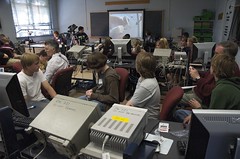

MLTI Student Tech Conference 2008
Tomorrow morning at 5am I will be on a bus with 40 7-12th graders headed for the largest student tech conference in the state. The kids are excited to go and be part of the 1000 participant event, learning from and with students in workshops with topics like Scratch with an MIT Scratch team member, internet radio streaming by kids, Legos & robots, Alice, Google Earth & Maps, and so much more. Most of the workshops are led by the students and a teacher or two, sharing what wonderful things they’ve been doing with technology in the classroom this year.
Final Session with 800+ students with laptops. Photo by Alice Barr
The final session is after lunch, and involves all 1000 student participants and the chaperones. This year the focus is on social action and global connections, and one tool we’ll be using is FreeRice.com Now, I know many of you have used this with students already, but this time we’ve got a stand alone Free Rice site built just for the MLTI conference. It will be reset to zero tomorrow at 1:00, and then we’ll begin accumulating grains of rice to address world hunger. This is where you come in! The site is open to all, and your grains of rice will count as long as you start after 1:00 EDT (-4 UCT). The details are below, but the key is to go to: http://MLTI.freerice.com and participate with the 1000 students in Maine as we see how quickly we can raise the rice totals.
The MLTI Student Tech Conference is a wonderful event for Maine students. I hope you will lend a few minutes of your time, and perhaps that of your students, to participate in this one small step to addressing world hunger. – Thanks — Sarah
From Jim Moulton:
(PLEASE NOTE: Though the http://mlti.freerice.com site is now live, rice “earned” via the site in advance of the 1 PM EDT (5 PM GMT) start time for the Conference session will not be “counted.” Once the conference session begins, the site will be re-set, counting of contributions will begin fresh, and the site will remain live until the amount of rice available for donation has been exhausted.)
Maine students and the World Food Programme invite you to join in helping to feed the hungry around the globe via http://mlti.freerice.com
On May 27, 2010 at 1 PM EST (5 PM GMT) during the 7th Annual MLTI Student Conference, students from across Maine will be going to MLTI.freerice.com as a body – working in a wireless environment that has been fine tuned by network technicians of the University of Maine System and Cisco to facilitate 1000 simultaneous connections. But in 2010 purposeful use of social networks has to be a part of taking on any major effort, and so Maine educators are reaching out across their state-wide, national, and worldwide human networks to invite others to join us in donating rice via a customized version of FreeRice.com.
To learn more about the 7th Annual MLTI Student Conference, please head here: http://www.mlti.org/studentconference
To join us in helping to fight world hunger, go here: http://mlti.freerice.com
To help fight hunger in Maine, go to http://www.gsfb.org
To help fight world hunger beyond the conference, head to http://freerice.com
Tuesday, May 25, 2010
Texas, CCSS & Corporate Political Control
 I'm so glad I live in Maine and not Texas. After doing a bit of research, I realize how much political control there is in determining how schooling is delivered in that state. And the sad part of it is that there seems to be increased collusion between corporate textbook publishers and politicians. There even seems to be an attempt to shut down any use of open source materials in teaching unless it has been approved at the State level. From my perspective, this is big government and corporations mandating what parents and teachers should think and say. How did this happen in a state known for the independence of thought and the self-reliance of its citizens?
Sadly, what is happening in Texas seems to be happening to the rest of the country as well through the Common Core State Standards in which politicians and corporations are determining what is to be taught in our local schools in an attempt to commodify and standardize as though people were simply widgets and cogs in a machine rather than complicated, but warm human beings.
 Oddly enough, some Texans are speaking of the CCSS as being a plot by progressives to indoctrinate children. The truth of the matter is that CCSS is being promoted by conservatives and liberals alike. It is being pushed by the Business Round Table, politicians, and many conservative think tanks and foundations, as well as huge textbook publishing companies.
Who should control education in the United States? Local citizens, educators, and school boards . . . or rich and powerful state and national entities and interests?
What do you think?
Cartoon Credit
Subscribe to:
Posts (Atom)


